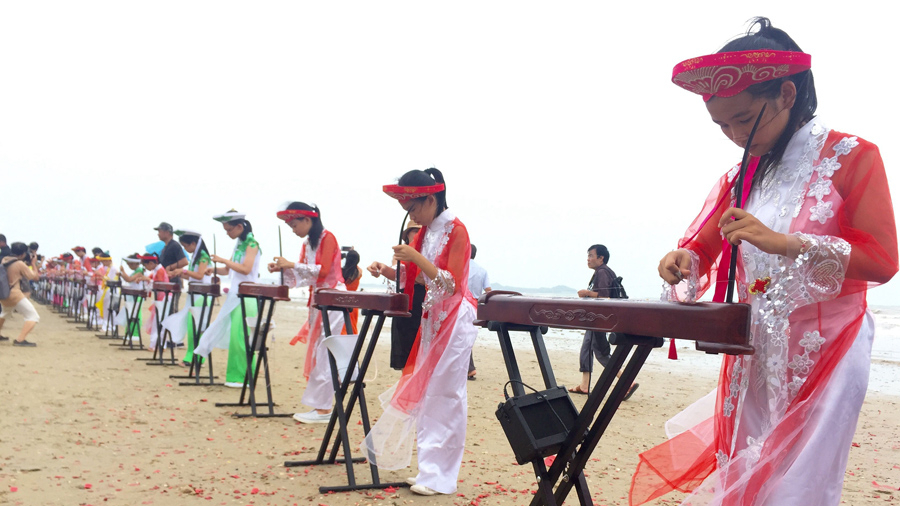
Ha Festival
Introduction
The Ha Festival, also known as the Changha Festival, is a vibrant cultural event celebrated by the Jing ethnic group in Dongxing, Guangxi Zhuang autonomous region. This festival is an epitome of the rich marine culture of the Jing people, who primarily reside on three islands: Wanwei, Wutou, and Shanxin. Characterized by traditional music, dance, and rituals, the Ha Festival offers a glimpse into the unique cultural traditions and lifestyle of the Jing people. Central to the festival's musical celebrations is the duxianqin, a one-string dulcimer, which not only enriches the festival's auditory experience but also serves as a cultural bridge, connecting the Jing people with their historical roots and neighboring Vietnamese communities. The Ha Festival was recognized as a national level intangible cultural heritage in 2006, and duxianqin recognized for the same honor in 2011.
History
The origins of the Ha Festival date back to after the Ming Dynasty (1368-1644) period, although its rituals are believed to have ancient roots that align with the Jing people's ancestral practices. The festival is traditionally held on the ninth day of the sixth month on the Chinese calendar, which usually falls in late July. It commemorates the cultural heritage of the Jing people, highlighting their seafaring lifestyle and devotion to the sea's bounty. Historically, the festival has served as a platform for social interaction, cultural expression, and collective worship. It was during these celebrations that the duxianqin became an integral part of the cultural identity of the Jing people, symbolizing their enduring musical traditions.
Significance
The Ha Festival holds profound significance for the Jing ethnic group, serving as a vital expression of their cultural identity and community solidarity. It is a time for honoring the sea, which plays a critical role in their daily lives as fishermen and seafarers. The festival's rituals and performances are believed to ensure bountiful harvests from the sea and to protect the community from adverse maritime conditions. By bringing together families and communities, the Ha Festival strengthens social bonds and fosters a sense of belonging among the Jing people. It is also a significant cultural event that attracts visitors and promotes cultural exchange, contributing to the local economy and tourism.
Celebrations
Traditional Rituals
Traditional rituals during the Ha Festival are deeply rooted in the spiritual and cultural practices of the Jing people. These rituals typically begin with sacrificial offerings to the sea deity, performed by community elders in traditional attire. The rituals are meant to honor and appease the divine forces believed to govern the sea, ensuring safety and prosperity for the fishermen. Accompanied by the duxianqin's ethereal music, the rituals set the stage for the festival's communal celebrations. Sacred dances and chants are performed by dancers dressed in vibrant ethnic costumes, creating a spectacular visual and auditory experience that reflects the community’s reverence for tradition and continuity.
Modern Adaptations
In recent years, the Ha Festival has seen various modern adaptations to accommodate broader audiences and enhance its appeal, especially among younger generations. While traditional rituals remain at the festival's core, additional activities such as cultural workshops, musical performances, and interactive exhibitions have been introduced. These adaptations aim to educate visitors about the Jing culture and history, as well as to provide an engaging platform for cultural expression. Technology has also played a role in modernizing the festival, with performances being broadcast on television and online platforms, thereby reaching a global audience and increasing awareness of the Jing culture.
Cultural Impact
The cultural impact of the Ha Festival is significant, as it serves both as a preserver of Jing traditions and a catalyst for cultural exchange. The festival not only reinforces the cultural identity of the Jing people but also showcases their rich heritage to the wider world. It has become a symbol of cross-cultural interaction, particularly between China and Vietnam, as the shared musical traditions and ancestral ties foster a sense of unity and mutual respect. The festival's role in promoting local tourism and economy cannot be understated, as it attracts thousands of visitors, providing a boost to local businesses and cultural institutions. Moreover, the Ha Festival plays an essential part in the survival and transmission of intangible cultural heritage, such as the duxianqin music, ensuring that these traditions continue to thrive and evolve with each generation. Through the festival, the Jing people assert their place in the cultural mosaic of China, contributing to the diversity and richness of the nation's cultural landscape.








